on my Japanese Maple

Inspired by Greg Linscott’s pics of his fall in Maine, [more here] I thought I would give you a couple of pictures of our Japanese Maple in our front yard. Unfortunately I didn’t think of this when it was at its peak, but some of its beauty and brilliant reds can be seen in these pictures. It is really a breathtaking sight for about a week every fall.


And now for a close up of the leaves. I’ve got it on my computer now as the desktop background.


The earth is the LORD’S, and the fulness thereof; the world, and they that dwell therein.
Ps 24.1

Regards,
Don Johnson
Jer 33.3

on catching up with sermon summaries

The latter half of last week was overwhelming with work, hence no blogging. I still have things to say, but had no time to say them!

This post will give a condensed summary of the preaching for Week 8 in our Through the New Testament series, otherwise entitled “The Revelation of Jesus Christ“, since that is what I think the New Testament is from beginning to end.

Wednesday evening gave us “The Shock of Betrayal”, a message that covered the Lord’s shocking announcements of betrayal and denial at the last supper, the institution of communion, and the prayer in the Garden culminating in the actual betrayal. What is particularly interesting to me about these events is that the Lord was dealing with the disciples yet again about rivalry over place and position. Edersheim speculates that the dispute was over where the disciples would be seated at the table and gives a plausible suggestion as to how the seating ended up. John’s gospel reveals that the way the Lord taught them about this issue was with the footwashing, which Judas participated in. As the Lord is instituting something as momentous as Communion, he is also dealing with pride, rivalry and humility in teaching his disciples right to the end. The repeated lessons to the disciples on this subject (at least three separate occasions) point out to us the significance of the problem of pride and political rivalry among disciples and also point us to the Lord’s answer to it: service.

Sunday morning, we began with “The King on Trial“, a look at the Jewish trial of the Lord with its three hearings, then the Gentile trial of the Lord with its three hearings. In the Jewish hearings, the high priests are on a fishing expedition, first before Annas, the former high priest, then before Caiaphas (Annas’ son-in-law) the current high priest. In the second hearing, Caiaphas gets what he wants when he gets the Lord to respond to the question whether Jesus is the Messiah, the Son of God. The Lord replies in the affirmative, then ‘ups the ante’ by saying that the priests will see him seated at the right hand of power and coming in the clouds of heaven (shekinah glory). The priests have the evidence they need. A. B. Bruce gives four reasons why Jesus answered this question when he was silent before all the other accusations:

  1. “The whole ministry of Jesus had made the question inevitable
  2. “The high priest was the proper person to ask it
  3. “It is an important opportunity for giving expression to His Messianic self-consciousness
  4. “Silence would, in the circumstances, have amounted to denial.”

[A. B. Bruce, “The Synoptic Gospels”, Expositor’s Greek Testament, Vol. 1, p. 320.]

After a daylight hearing to make the charges and sentence against Christ legal, the priests send Jesus to Pilate to get Roman approval for the sentence of death. Pilate waffles, realizing the charges are ludicrous, but with the vehemence of the Jews, finds no way out. He attempts to get Herod to take the monkey off his back (second hearing) with no success. Then he finally gives in as the mob joins the priests in shouting for the Lord’s crucifixion.

I centered this message around 1 Cor 1.18-25, especially the phrase “the Jews seek a sign, the Greeks seek after wisdom” and the bit about Christ being a “stumblingblock to the Jews and foolishness to the Greeks”. This is on display in the whole trial scene. But to us who are saved, “Christ the wisdom of God and Christ the power of God”. The proposition for this message was: Your eternal destiny depends on what you see in the humiliation of Christ.

The second message was “The Dying Saviour Speaks“, where I focused on the four sayings of Christ on the cross that are recorded in the Synoptics. (There are three more in John.) My theme was forgiveness and my proposition went this way: The purpose of God in the crucifixion of Christ was fully accomplished: wrath against sin is eternally satisfied, escape from wrath for sinners is eternally supplied. My main points were

  1. Prayer for temporal forgiveness – for sins of ignorance (Father, forgive them… Lk 23.32-38)
  2. Promise of personal forgiveness – to a penitent sinner (Today you shall be with me… Lk 23.39-43)
  3. Place of all forgiveness – wrath outpoured on the innocent Son(My God, My God… Mk 15.33-34, Lk 23.44-45)
  4. Pathway to forgiveness – blazed by the faith of the Son
  5. (Father into thy hand… Lk 23.46)

The Son entrusted his soul to the Father, and so must we, based on the work of the Son.

The last message focused on the burial and emphasized the witnesses to the fact that Jesus really died. The title was “Witnesses to His Death“. In this message, we reviewed the Lord’s repeated teachings to his disciples concerning his death, the witnesses to his death, including the centurion, the soldiers, the councillors (Joseph and Nicodemus), the women watching, and even the chief priests and Pharisees as they asked for a guard against false claims by the disciples about a resurrection. We really didn’t cover anything new in this message, but I pointed out that it took the disciples a long time to understand the Lord’s teaching on this matter. On one occasion, the Lord said to the disciples

Luke 9:44 Let these sayings sink down into your ears: for the Son of man shall be delivered into the hands of men.

In the same way we need to let the teaching of Scripture sink down into our hears, to meditate upon it, to contemplate it again and again so that we might more fully understand the implications for our spiritual lives as we ground our hope of eternal life in the real death of the infinite Son of God.

Well, now I am caught up on summaries. I’m off to clean the gutters on our house … it’s cleaning day and my wife has some needs that must be met. I’ll post more later.

Regards,
Don Johnson
Jer 33.3

on Olasky and Compassion

The Tragedy of American Compassion – Marvin Olasky (Washington, DC: Regnery Publishing, 1992), 233 pp.

A book review by Donald C S Johnson, pastor, Grace Baptist Church of Victoria, Victoria, BC.

Olasky sets out to do two things in this book. The first is to provide a survey of methods and means of distributing charitable care to the poorest of society throughout American history. The second is to argue for a return to methods of care long since abandoned in the welfare state. Olasky optimistically states ” The good news is that the impasse can be resolved. Many lives can be saved if we recapture the vision that changed lives up to a century ago, when our concept of compassion was not so corrupt.” [p.5]. The first goal appears to be reasonably well met and readers will find Olasky a helpful resource to understanding what has been done. Olasky certainly argues vigorously for the second goal, but whether he achieves his end or not is not entirely clear. It is not that he failed to convince this reader of the failure of universal governmental welfare statism, but whether his alternative is likely to succeed in the current climate is still open to question.

The history of social work in America begins at the local level, when America was a nation of townspeople and country folk where the poor were your neighbours and you knew their names. Those who were poor due to their own indigence were subject to local censure and shaming, those who were poor through calamity or hard times were given opportunities to get back on their feet and rejoin the productive majority. The philosophy of the times is a result of the biblical view of man as depraved, needing discipline and compassion. Olasky calls this approach the approach of ‘Social Calvinists’ [p. 10]. The poor person sat on a three legged stool of family, church, and neighborhood. As long as America was a nation of towns, the three legged stool remained steady.

As America grew into a nation of cities, managing the problems of the poor became more complex. Cities provide economic opportunity and anonymity. Vice increases in concert with anonymity. Charitable efforts are complicated by the increasing distance between those who give charity and those who receive it. In the early 1800s, the increasing complexity of city life led charitable institutions and organizations to call for many volunteers – amateur social workers – whose responsibility was to be involved in the lives of those being helped to discern need and ability for self-help. The charities learned that giving out gifts in kind (wood for heat, groceries, etc.) rather than simply dispensing cash was much more successful. One evaluation of government charity from that day evaluated the work of the city of Philadelphia: ” The Philadelphia committee worried that the City of Brotherly Love’s willingness (very unusual for the time) to support women with illegitimate children was ‘an encouragement to vice, and offers a premium for prostitution.'” [p. 46]. You get what you pay for, apparently.

In the 1840s a shift towards government involvement and an abandonment of means testing was championed by Horace Greeley, publisher of the New York Tribune (and author of the famous quote, “Go west, young man.”). Greeley was a Universalist who not surprisingly did not subscribe to the biblical notion of human depravity. His efforts championed a change in social work pre-Civil War toward more government involvement and more universalism in support, with no concern for ability of the poor to work or not. As a political conservative would expect, such governmental interference met with only in increased demand for charitable support rather than a reduction in poverty.

The Civil War abruptly changed the national focus and post war programs for the poor diverged in two directions. The largesse of universalism was discredited to be replaced with views of ‘Social Darwinism’ which essentially suggested that only the fittest should survive. Some advocates of these views expressed not compassion or aid, but eugenics. On the other hand, churches and Christian organizations emphasized the need for total personal reformation – reforming the whole man, not just filling the empty hole in his stomach.

“Christians observed that Jesus neither abandoned the needy nor fed them immediately — instead He taught them. (In Matthew 15, Jesus feeds thousands after they have listened to Him for three days. In Mark 6, Jesus first teaches — ‘He had compassion on them, because they were like sheep without a shepherd’ — and only late in the day multiplies five loaves and two fish, so all eat and are satisfied.)” [p. 71]

In the era between the Civil War and the Great Depression, poverty relief largely was the domain of religious organizations, both church based and broader efforts supported by multiple churches and individuals. These institutions insisted on seven principles of charity, or The Seven Marks of Compassion, as Olasky calls them:

  • Affiliation: restoring/repairing/rebuilding family ties [perhaps making dysfunctional families functional], or creating new social groups such as a ‘church family’
  • Bonding: for those truly alone, bonding with a new group – the charitable volunteers, or a church family
  • Categorizing: those asking for help must be evaluated, not everyone treated equally. Help differs depending on able-bodied or not, mentally competent or not, etc. Key: work tests – will he chop wood for an hour? etc.
  • Discernment: ‘benign suspicion’ from a theology of the depravity of man
  • Employment: the goal of charitable work is to enable long-term employment of the able-bodied; stresses the importance of work
  • Freedom: not ‘the opportunity to do anything with anyone at any time, but as the opportunity to work and worship without governmental restriction’ [p. 111] — i.e., you don’t have to bribe someone to get a job, or to start your own job
  • God: philanthropy must meet spiritual as well as physical needs – teach people to love God and godliness; hard work, frugality, self-restraint

The Great Depression changed everything. The need was so immense, private charities alone were soon outstripped in their ability to help. Franklin D. Roosevelt brought in major change to government involvement with his New Deal programs.

‘The great depression of the 1930s revolutionized social work,’ Frank Bruno wrote. ‘Instead of being the Cinderella that must be satisfied with the leavings, social work was placed by the depression among the primary functions of government.’ [Frank Bruno, Trends in Social Work, 1874-1956 (New York: Columbia University Press, 1948), p. 300, quoted in Olasky, p. 155].

The New Deal programs still emphasized working in return for aid, but the heavy involvement of government in the field of social work was here to stay. Social work increasingly became the province of professionals, volunteers and private charitable organizations were de-emphasized as time went on. By the 1960s and Lyndon Johnson’s Great Society, the triumph of socialism ‘cornered the market’ for the government in social work, so to speak.

“Until the 1960s, the public dole was humiliation, but thereafter young men were told that shining shoes was demeaning, and that accepting government subsidy meant a person ‘could at least keep his dignity.’ This, then, was the key change of the 1960s — not so much benefit programs as a change in consciousness concerning established ones, with government officials approving and even advocating not only larger payouts but a war on shame. Underlying the change were the theologically liberal tendencies within social work (and related fields) that had been criticized by Niebuhr a generation earlier, and which were becoming more evident than ever.” [pp. 168-169]

Olasky’s survey brings us up to about 1990, sixteen years ago now. Recent trends in compassion are not discussed and a revision of the book discussing some of the current efforts like George W. Bush’s “Faith-Based Initiatives” would make the discussion current.

To sum up, there are three main views discussed in the book: the evangelical view of the depravity of man coupled with the Christian call for meaningful and productive compassion; the liberal/secular view of the essential goodness of man and the call for universal rights and wealth redistribution; and the hard-hearted social Darwinist view that argues for letting the poor weed themselves out of the system. It seems to me that there might also be a fourth view from a laissez-faire economists point of view that could resemble the social Darwinist in some ways, but also emphasize the value of work and insist on discipline and effort from each individual, without a real Christian ethos. Olasky doesn’t discuss this view, perhaps because it has never held significant sway in American history.

Olasky’s discussion provides some excellent insights, the chapter on the Seven Marks of Compassion is especially helpful and could provide some principles for guiding Christians and Christian churches in their social efforts.

Where Olasky’s book fails, in my view, is to come to grips with the massive problem facing modern welfare states. There is a tremendous amount of inertia created by fifty years of the dole and the dependency that it has created. Politically, a dramatic shift in policy seems impossible, and a shift in policy by incrementalism requires long term effort, dedication, and a wholesale change in government philosophy by the citizens. Incrementalism will likely prove to be too slow and is subject to reverse incrementalism as shifts in political fortunes favor one side or another. In addition, although I agree in the main with Olasky’s view of the general principles which compassionate work should follow, I don’t see how Olasky or anyone he cites has really grappled with the problem of mega-cities and the masses of people who are dependent on some kind of government subsidy. Surely there is a solution to these problems, but merely re-energizing faith-based organizations seems insufficient to me. How can these initiatives really compete with the government? As one director of a New York street mission complained,

“rescue missions are seen as just another welfare program. … The men who come to us confuse us with the welfare department. A man feels the mission … is not really doing its job unless he gets what he thinks he is supposed to get. Now this is the attitude of the ‘client’ and not the attitude of a man seeking love and friendship and spiritual help. The early mission did not have this to contend with — this feeling that ‘the world owes me a living.'” [Earl Vautin of the McAuley Mission, quoted in Arthur Bonner, Jerry McAuley and His Mission, (Neptune, NJ: Loizeaux Brothers, 1967), p. 110, quoted in Olasky, p. 185]

The current climate seems not tremendously different from the climate of the sixties in which Vautin was making his comments.

Finally, some guidance for Christians in how to effectively give others a hand up rather than a hand out are outlined in this book. It is worth reading as a reference to what has gone before and for ideas on how to be effective in helping individuals today. The book does not argue from Scripture specifically, though it does allude to scriptural principles. The scriptural mandate for Christian involvement in charitable work must come elsewhere. This book provides some practical insights to guide whatever Christian involvement might result.

Regards,
Don Johnson
Jer 33.3

on separation simply summed

One of the great difficulities in understanding separation is what to do with the brother who differs with me at some point but not every point. I am talking here about brethren who in the main are separatists. When brethren will separate with unbelief and apostasy and certain forms of disobedience, how are we to relate to them if they allow some forms of disobedience that I do not allow? What are they to do with me? [Of course, by disobedience, I mean disobedience as I understand it – our definitions here tend to be fairly subjective.]

For example, there are brethren who do not compromise themselves with apostasy but who will allow greater latitude in music than I will. At some points, some go so far in this area that I couldn’t support their gatherings, though I would not be uncomfortable with personal fellowship, or even with having such a man support my gatherings. [This is only an example, please don’t get sidetracked by the subject of the example!]

But there are other examples. Suppose a man wants to be a part of fundamentalist fellowship but is an active supporter of Samaritan’s Purse or other such causes? What then?

One of my sons was in a conversation with some fellows along these lines. In their defense, we must note that they are young, untrained, and not in a position of leadership. But there may come a point when their views matter, and decisions would have to be made concerning fellowship. That point is not now. But what was significant to me in the report of this conversation was an observation my son made to me:

“To be a fundamentalist doesn’t mean you have to be always on the same page, but you do have to at least be in the same book.”

I thought that summed it all up rather well. There is quite a diversity of applications of separation. Sometimes our separating brothers make us uncomfortable with what they do or don’t separate from. I am pretty sure that I make my separating brothers uncomfortable with what I do or don’t separate from. But we are separating brothers. We are fundamentalists in philosophy, whether we use the label or not.

Those who are fundamentalists might not all always be on the same page, or even in the same chapter, but they are in the same book.

Regards,
Don Johnson
Jer 33.3

on the 10.15.06 sermon summaries

We are in the midst of the last week of the Lord’s life. The chronology of that week are somewhat of a controversy, depending on which day you think the Lord was crucified on. Thursday advocates point out that you have a ‘silent day’ in the week if the crucifixion is on Saturday and scoff at the notion that the three days and three nights in the tomg can be accounted for by the Jewish practice of counting part of a day as a whole day. Friday advocates will note, for example, that the women waiting to administer extra spices to the body of Jesus waited over the Sabbath singular, not the Sabbaths plural as is required by the Thursday view [instead of one Sabbath, the Thursday advocates say there are two Sabbaths, one a special occasion Sabbath due to the way the Passover works, etc.] The argument is all quite complicated and it is difficult for me to discern the significance.

I tend to support the Friday view and take the day of silence to be the Wednesday before Passover on Thursday evening, a sort of ‘self-imposed sabbath’ by the Lord in preparation for the trial that is to come.

All of that to say that the events we are looking at this Sunday occurred on the Tuesday of the Passion Week. The first event we covered is the Lord’s last public message, recorded most fully in Mt 23. The proposition of the message is: “The manner in which error is opposed depends on the spiritual condition of the people being addressed.” The first group addressed in the sermon is ‘the multitude’ and the disciples. The Lord teaches them to listen to the biblical teachings of the Pharisees, but warns them against following their practices. He contrasts the self-seeking practices of the Pharisees with the Christ serving practices of kingdom disciples. So the manner in which the Lord addresses the crowd is as a teacher. The second group addressed is the Pharisees – the Lord pronounces at least eight woes (curses meaning ‘you are as good as dead’) on the Pharisees. The point is that they have so twisted things that they themselves aren’t entering the kingdom and they are in fact preventing others from entering also. This part of the message is direct and pointed. The Lord minces no words in rebuking the Pharisees. So the manner in which false teachers are addressed is full of opposition, rebuke, and condemnation. [And we must beware lest in our zeal for the Lord we fall under the same condemnation.] The third part of the message is to the nation: “O Jerusalem, Jerusalem”. The Lord acknowledges the nations wickedness but in compassion assures the nation that if she would turn, he would receive. But ‘ye would not.’ So the manner of addressing a sinning nation and a sinning world is the message of compassionate forgiveness to those who are willing to acknowledge their sin and turn to Christ.

The whole chapter is one of sober reflection, brought about by the Lord’s strong words against the Pharisees. It seems that this is the last provocation, and it brings about the crucifixion three days later.

The second message dealt with the Olivet Discourse in Mt 24. After leaving the temple area, the disciples remark on the beauty of the temple buildings. The Lord prophesies that not one stone will be left standing on another. The disciples are shocked, and, upon arriving on the mount of Olives outside the city (in the Garden of Gethsemane?) the Lord answers their questions concerning the end of the age. The proposition for this message is: “The Lord’s preparation of his people for the end of time provides assurance to saints who live in uncertain days.” The first point is that of reassurance to saints in a troubled church age (4-14). I realize that some dispensationalists do not see the church at all in this chapter, but in this section, the Lord describes general conditions that exist now, no signs, and states: “don’t be troubled … the end is not yet”. So I take this to be reassurance for the church age. The second point involves signs, and is II. revelation for saints in a time of great trouble (15-28). Here is the abomination of desolation and a lot of trouble and concern. Here Matthew tells the readers (not the hearers) to understand. Here the Lord clearly explains that the Second Coming will be unmistakable. The last point is this: relief for saints in the time of dire distress (29-51). The Lord gives these words to those who are in that time of great trouble to reassure them that he is coming and to warn them to be ready. We can apply this to us as well. We are in times of distress. We should not be discouraged, but we should be ready.

Our last message involved a few events recorded in Mk 14.1-16 (and elsewhere) that I called “Preparation for the Passover“. The chief priests and the scribes were preparing for murder, a preparation of malice. Mary (named in John’s Gospel) prepared the Lord for baptism (on the Saturday preceding) by anointing his head with spikenard, a preparation for burial. Judas was preparing the passover by joining the plot to deliver over his Master (did this occur on the ‘silent day’, Wednesday?), in a preparation for betrayal. And Peter and John (identified in Luke) were sent to prepare the passover in the upper room for the Lord and his disciples. I went through the steps of preparing the passover lambs found in Edersheim’s The Life and Times of Jesus the Messiah for this section. This is a preparation of obedience. I didn’t really have a proposition for this message, but this is where I was going in the conclusion:

• The priests were preparing the passover – they wished to slaughter the Lamb of God.
• Mary prepared the passover – she wished to honour the Lamb of God.
• Judas prepared the passover – he wished to give away the Lamb of God.
• Peter and John prepared the passover – they wished to eat meat with the Lamb of God.

What do you wish to do with God’s Passover Lamb?

Regards,
Don Johnson
Jer 33.3

P.S. Sermon notes can be seen by clicking the links in the article.

more pics from our work day

I meant to add more pictures to that last post, but got confused at what blogger was doing. This one is a view of the back yard where we were fighting brush on the fence. The new fence and townhouses are in the back view. One of our guys, Edouard, from Russia, is working away on the brush.

This picture is at the end of the day, looking out from the parking lot to the road, with my trusty truck in the foreground. There used to be a fence there by the big fir tree (another object destined for destruction).

Regards,
Don Johnson
Jer 33.3

on just a great day with my church men

Today was one of those highlight reel days of the ministry. We had a work day at the church, attended by most of our men. The only ones that missed were those who are too feeble or those who had other unavoidable commitments.

We had two projects today: cleaning the gutters and removing a chain link fence on two sides of our property. The gutters are just maintenance, but the fence came up because of a new development behind us. In the property next to ours, we have been watching 14 townhouses go up over the last year or so. They are just finishing up now, and put up a new fence behind the townhouses. The fence was 10-20 feet away from our fence, so I asked the developers what was up with it. He said the fence was on the property line! I was surprised that so much property back there actually belonged to our lot. Of course, before the developers came along, there was a gully back there which carried a winter stream. So our fence was built on the ridge of the gully instead of on the property line.

Well, I could just see that area between the two fences becoming a tangle of weeds if we lef the fence up, so we decided to take it down. That meant contending with blackberries, broom, and other brushy types of plants that had invaded from the former gully and had intertwined themselves with our fence. What a job!

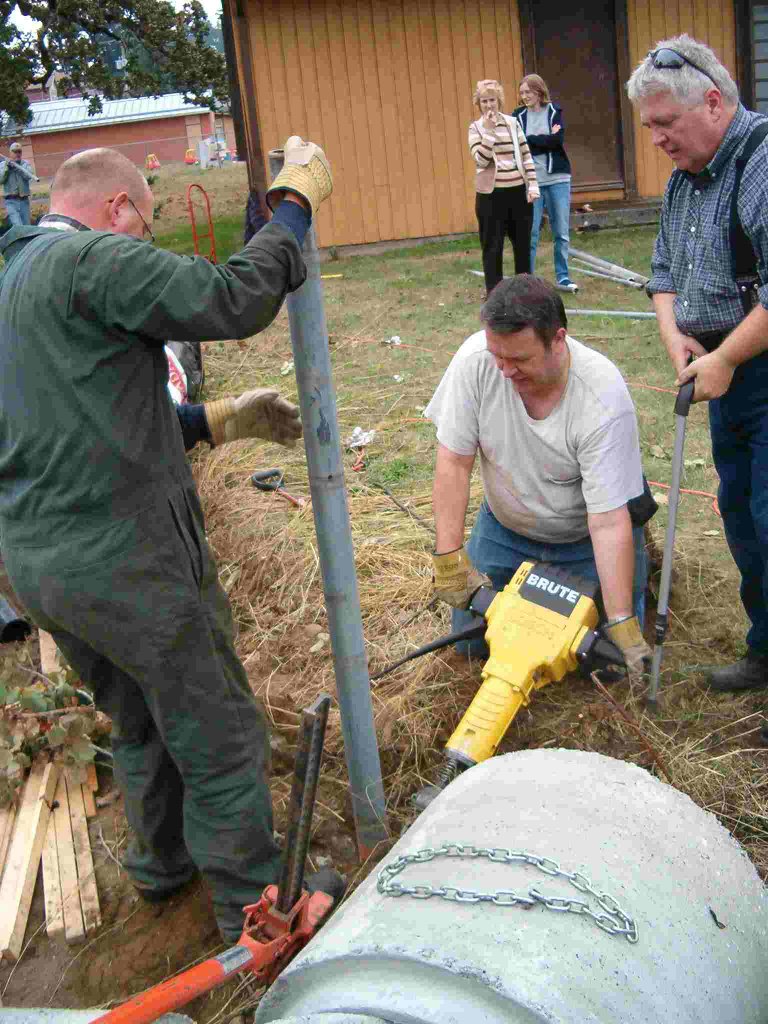
After the chain links and connecting poles were removed, it was time for the posts. Jack-hammer time, my first experience with such a machine. The guys who built our church building way back when were excellent builders. They did everything top notch, which is to say, very, very, very solid. The corner posts were encased in two pours of concrete. The rest of them had a pretty skookum amount as well. [The top picture is me using the jack hammer on a corner post – notice the name of the machine – I called the pic ‘brute on Brute’. My wife and daughter are supervising in the background.]

Well, we all took turns on the hammer, and managed to get all the posts out. Some of them are even still intact. Our property now looks strangely open and inviting. We probably should have done this a long time ago!

My wife brought over lunch for us all. She’s a good girl, I guess we’ll keep her! After we finished the job, we sat around in the fellowship room and just talked. What a great time. These guys are the highlight of pastoral ministry. I wrote recently about some of the challenges, but this kind of day is filled with God’s good grace and his blessedness in working in the hearts of men.

And tomorrow is the day of worship! I think we are ready this week!

Regards,
Don Johnson
Jer 33.3

on the called

In my recent studies I noticed a little word in Mt 22.14.

NAU Matthew 22:14 “For many are called, but few are chosen.”

The word is ‘called‘. Why the distinction of the ‘many’ who are ‘called’ and the ‘few’ who are ‘chosen’?

Tom Constable says “Not all whom God has invited to the kingdom will participate in it. Only those who respond to God’s call and prepare themselves by trusting in Jesus will.” [See Note 1 below.]

The adjective ‘called’ is used ten times in the New Testament. Most of the time it delineates the saints of God or someone called to a special task. Paul is called to be an apostle in Rm 1.1 and 1 Cor 1.1. Paul calls the Romans ‘the called of Jesus Christ’ in Rm 1.6. In Rm 1.7 they are ‘called as saints’. In Rm 8.28, the well known ‘all things’ work together for good to all who ‘are called according to His purpose’. In 1 Cor 1.2, the Corinthians are ‘saints by calling’ and in 1 Cor 1.24 Paul distinguishes between the Jews and the Greeks and ‘those who are the called’. Jude writes to ‘To those who are called’ in Jude 1.

The only other use of called is Rev 17.14:

NAU Revelation 17:14 “These will wage war against the Lamb, and the Lamb will overcome them, because He is Lord of lords and King of kings, and those who are with Him are the called and chosen and faithful.”

In this verse likely the three terms are likely in apposition to one another. While one could imagine some who were called not being chosen, it is hard to imagine those being ‘with Him’ on this occasion as being a further subset of the chosen called ‘the faithful’.

Thus, in every case but the first instance the term either refers to one called to be an apostle or to saints who equal the called. Why then does the Lord say, “Many are called but few are chosen”?

The answer appears not to lie in an examination of usage but in the context. In the parable for which this statement is the conclusion the a king invited guests to the marriage supper of his son, but they would not come. Then he sent his servants after them and they went off on their own pursuits and misused them. Some of them they killed. The king was angry and sent his soldiers to destroy the murderers and burn their city. All of this is a picture of Israel and the destruction of Jerusalem in AD 70.

Then the Lord sent his servants to invite bad and good from the highways to fill his banquet table. This they did until the banquet hall was filled. This parallels the preachign of the gospel to the entire world, filling the kingdom with citizens of every race and tongue.

One among these came to the supper without a wedding garment. The king rebuked him, and sent him out to outer darkness where there is weeping and gnashing of teeth. Then the Lord says: ‘For many are called, but few are chosen.’

Clearly the many included Israel and they include the man without the wedding garment. What is the difference between the guests who remain and all these? They responded to the invitation and they clothed themselves appropriately.

While I suppose we cannot build a doctrine solely on one parable, it appears that the meaning of this passage is that the gospel invitation goes to many (and in scriptural context we would say this means ‘all’) but only those who respond appropriately are the ‘chosen’. Thus in this parable and passage we see the doctrine of the unlimited atonement and conditional election.

I have many friends who are not comfortable with my views here, but how else to explain the Lord’s words?

Regards,
Don Johnson
Jer 33.3

Note 1: Tom Constable. (2003; 2003). Tom Constable’s Expository Notes on the Bible (Mt 22:14). Galaxie Software.

on An Afternoon of Questions

In our NT study, we are now to the place on the Tuesday (presumbably) of the Crucifixion week where the various Jewish parties have conspired together to catch the Lord in an embarrasing question. I am presuming that this occurred in the early afternoon, but it could have been earlier in the day. My proposition for this message was: It is utter folly for men to attempt to ‘match wits’ with God.

The attack begins with a political question, is it lawful to pay taxes to Caesar. They are hoping for a straight yes or no answer, either one of which could cause problems for the Lord, with the crowd or with the Romans. The Lord artfully answers ‘Yes’, but in such a way that no one could object to the answer. The Lord will not be trapped with such an easy question as this.

The second attack comes from the Sadducees with the theological question about the woman with seven husbands, all brothers. Who will have her in the resurrection? They have invented this sophistry as a means of mocking the doctrine of the resurrection. The Lord corrects their understanding of the human condition in the resurrection, then deals their doctrine a devastating blow by arguing from the tense of God’s statement to Moses from the burning bush: ‘I am the God of Abraham, Isaac, and Jacob.’ Not ‘I was…’ but ‘I am…’. The present tense establishes the fact of the resurrection. The fact is that mockers will think they can pose a problem so hard that God can’t be the answer – I once had a friend who couldn’t believe there was a fish so big it could swallow a man and spit him up three days later alive. My answer to him: ‘How big is God?’ People today want to say that science has disproved the Bible. My answer: ‘How big is God?’ The observable facts of creation are completely explained by a true and living God – those who find them mounting insuperable arguments simply don’t want to accept God as the answer.

The third question is a mild test of a legal question, but also an ‘almost, but not quite’ statement of kingdom faith. A scribe asks Jesus which is the great commandment and the Lord points him to the Shema (Love God with whole heart, mind, strength), and to the secondary commandment of loving neighbour as self. The thoughtful scribe responds that these two commandments are weightier than ALL burnt offerings and sacrifices. Jesus says that this man is not far from the kingdom. What he needs to get into the kingdom is to acknowledge the King, but this he doesn’t dare to do, as the opponents of Christ leave off questioning him. One finds himself hoping that this man was one of the three thousand on Pentecost.

Now it is the Lord’s turn, and he asks an unanswerable question. That is, it is unanswerable if you don’t like the answer. Jesus asks how David can call his son, Messsiah, Lord in Ps 110.1 ‘The Lord said unto my Lord…’ This question precisely zeroes in on the weakness of the Lord’s opponents. They will not admit his obvious identity – they will not accept his superiority – they will not confess that he is the God-man, the only son of God, come in the flesh.

As we see these questions, one has to wonder what the Lord would ask of me if he were to come and have an interview with me tonight. What lurking unbelief would he reveal with one simple soul searching question?

One also wonders how it is men think they can match wits with God. The answer? They don’t believe Jesus is God. That is why men dare to mock today. They question God’s word at many points, sounding very learned, but they have little faith in the God of the word. Their questions reveal it. Our lives can reveal it as well. How much faith do we have in the God of the Word?

Regards,
Don Johnson
Jer 33.3

Sermon notes here.

our Thanksgiving sermon

In Canada, Thanksgiving occurs on the second Monday of October. A few years ago I did some research on Thanksgiving to find out the differences between the American and Canadian versions. I think that the date difference has to do with an earlier harvest in our northern climes. And, of course, there are Canadians who claim that ‘we’ celebrated Thanksgiving ‘first’, before the Plymouth Pilgrims. Part of the Canadian psyche is an incredible inferiority complex towards the USA. We are founded on a negative principle, “We don’t want to be Americans.” From that flows all of our tortured way of thinking up here.

Well… whatever…

Sometimes it gets a bit painful to keep up the Canadian facade.

In any case, yesterday was Canadian Thanksgiving (and my brother’s birthday). In our church we have often celebrated Thanksgiving with a traditional Thanksgiving meal together with as many of our church people as have cared to come. Many of our folks are somewhat ‘disconnected’ – no immediate family in the area, or very limited relationships with the family that is here. So we are their family. When we started this, my wife and I lived in a half duplex and we could have the whole church over in our dining room, all ten of us. Thankfully, the crowd is a bit bigger now and we have a church building to hold it in.

Yesterday we invited my brother and his family ‘down-Island’ to provide music for our service and allow my brother to ‘sing for his supper.’ (I even made him give me the note to start ‘Happy Birthday’, since I am decidedly unmusical.) We had a crowd of about 50 people, including several lost family members of our church members. For one couple, it was the first time they had darkened the door of our church, although they only stayed for the meal and not for the service. I hope that the contact will allow future contacts and that they will respond to the gospel someday.

For the message, I was working my way through the passages in the Synoptics that cover the cursing of the fig tree, the cleansing of the temple, the challenge of the priests and elders (‘by what authority do you do these things’), and the three parables the Lord gives in response. Fortunately, the last parable was “The Wedding Banquet” so it fit in nicely with Thanksgiving. In the message I pointed out the theme of invitation in the Banquet parable. Those first invited refused, and even killed some of those sent to invite them. The response was wrath and destruction. From there, I turned to the cursing of the fig tree, the cleansing of the temple, the parables of the two sons (“I go, sir” but he didn’t go; “I won’t go” but he did go), and of the landowner whose tenants killed the landowner’s son. Each of these are either a spoken or an acted parable of the relation between God and Israel, the nation first invited to the banquet, but in denial and refusal to come. God then sends his servants on the highways to invite all to the feast. Those highways lead around the world, ending in Victoria, BC, and with many ports of call in between. The banquet hall will be filled, and the work of the invitation is ongoing. A final warning is given in the parable concerning the man who is improperly clothed. If you will enter the banquet hall, you will enter God’s way, not your own way.

Our proposition was this: “The invitation that many have rejected is still open to you.”

No one made any visible response, but we do pray that the word of God will have an effect. There were lost people in the service yesterday, so may God’s word speak with power to their hearts.

Regards,
Don Johnson
Jer 33.3